Acne scars and dark marks: choosing treatment for the actual problem
A flat brown or red mark after acne is different from an indented or raised scar. The first useful step is to identify whether colour, skin texture or both are the problem, while controlling new acne. Treatment can improve the appearance of selected scars, but complete removal or perfectly smooth skin cannot be promised for every person.
Contents
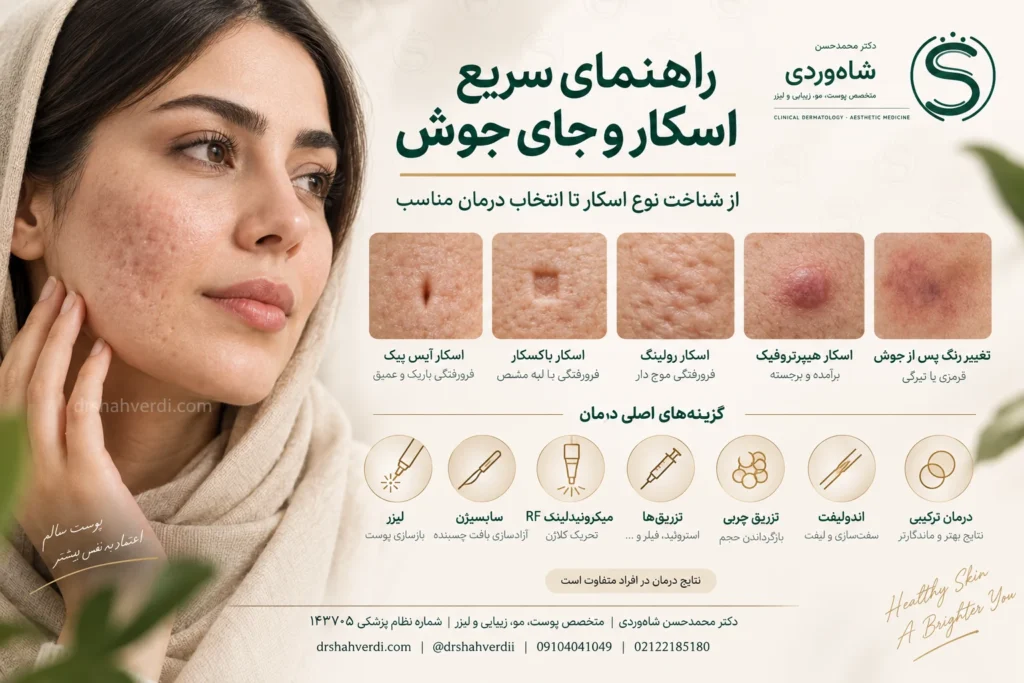
Is it a flat mark, a scar or both?
Post-inflammatory hyperpigmentation describes darker colour after inflammation. Residual redness may also remain after a spot. A scar changes the texture or structure of the skin, producing a depression or a raised area. Colour and texture can occur together; a dark mark alone does not prove a permanent scar. AAD explanation of acne scars.
Use words that describe the concern: flat brown patch, persistent redness, narrow pit, broad depression or raised lump. Enlarged pores are not automatically acne scars. The English dark-spots guide explains why pigmentation has its own assessment and care.

Why the scar pattern affects the choice
Depressed acne scars are often described as ice-pick, boxcar or rolling patterns. Raised scars have a different structure; some may behave as hypertrophic scars or keloids. These names help clinicians plan treatment, but photographs and home descriptions do not reliably select a procedure.
More than one pattern may be present on the same face. Point out the area you most want to improve rather than asking for one device to treat every mark. A method that addresses a depression may have little purpose for a flat colour change, while a cream for pigmentation does not release an underlying attachment.
Control new acne while discussing existing scars
Inflammation can damage the structures involved in skin repair. Deep or long-lasting acne, picking and squeezing can increase the concern about new scars. Early assessment of painful lesions is worthwhile; you do not have to wait until many marks accumulate. AAD scar causes.
The plan should explain both prevention and repair. If acne is still active, ask how it will be controlled before or alongside any proposed scar treatment. A procedure does not prevent future acne by itself. Bring the names and dates of current and recent acne medicines, especially oral isotretinoin.
Does PCOS cause a particular kind of acne scar?
A person with PCOS can develop acne and scars, but the ovarian label does not tell us whether a remaining mark is a scar, what scar type it is or which procedure is suitable. The skin examination and acne history answer those questions. Hormonal care may matter for recurrent acne while texture treatment has a separate goal.
Do not delay care for deep acne while waiting for a hormone problem to settle. Equally, an old scar is not proof of current abnormal hormones. The English PCOS and skin guide explains these distinctions.
What should a scar consultation cover?
Explain your priority, how long the changes have been present and what you expect treatment to improve. The clinician considers scar type, distribution, skin tone, previous pigmentation reactions, active acne and medical history. A budget and the recovery time you can manage are useful information, not awkward questions.
- Bring all current and recent acne treatments and previous procedure details.
- Mention keloids, prolonged dark marks, cold sores or healing problems.
- State pregnancy plans and medicines that may affect the procedure.
- Ask what change is realistic and how it will be compared.
- Clarify costs, planned stages, downtime and access to help afterwards.
Doing nothing immediately can also be a reasonable choice while the diagnosis, expectations or active acne are clarified.
Why there is no universal best scar procedure
Depending on the findings, a dermatologist may discuss resurfacing treatments, selected peels, microneedling, subcision, scar surgery, fillers or treatments for raised scars. Some people need more than one approach; others may not want or need a procedure. The specific scar structure matters more than a fashionable name. AAD consultation and treatment guidance.
Ask why each proposed component is included. Which part addresses colour, which texture, and which the prevention of new lesions? Discuss risks such as prolonged redness, pigment change, infection or additional scarring, and how the plan accounts for your history. Device settings and procedure selection cannot be safely prescribed from an article.
Availability and cost at Dr Shahverdi’s clinic must be confirmed for the specific method after assessment. A general explanation of a treatment is not a statement that every listed service is offered there.
Can natural remedies remove acne scars?
Gentle care, sun protection and avoiding picking can support the skin and reduce further irritation. They do not mechanically release a tethered depression, replace lost structure or establish treatment for a keloid. A claim that one household remedy removes every type of scar should prompt questions about the actual diagnosis and evidence.
Do not use lemon juice, aggressive scrubs, strong acids or home needling as a shortcut. Irritation and injury can leave another mark. If the concern is a flat pigment patch, its care is different from treatment for an indented scar. The AAD dark-spots guide explains the importance of addressing the cause and avoiding irritating products.
How should I compare Reddit stories and before-and-after photos?
Use a story to identify a question, not to choose a procedure automatically. People may have different scar types, skin tones and histories. Photographs can use different lighting, expressions or camera angles; a brighter photograph is not proof that texture changed.
Ask for a description of the actual method, follow-up interval, recovery and possible unwanted effects. Another person’s improvement does not guarantee yours.
Aftercare and a fair way to judge progress
Follow the specific aftercare given for your procedure rather than a generic social-media routine. Ask when cleansing, makeup and active products can resume, what protection is needed and which symptoms require contact. Increasing pain, spreading redness, discharge or a concerning healing change deserves timely advice.
Compare photographs in similar light, angle and expression at the agreed interval. Early swelling can change the appearance of depressions, so a very early image is not a final outcome. If the result differs from your expectation, review the original goal and the remaining scar pattern before adding another procedure.
Dr Shahverdi’s practical notes
The clinic’s published Persian scar guide advises separating colour from texture, taking active acne seriously, asking for the purpose of each added method and explaining previous pigmentation, keloids, cold sores and medicines. It also emphasises aftercare and asking about the actual technology, accompanying material and response to complications. A device name alone is not a treatment plan.
Questions patients ask
Is every mark after a pimple permanent?
No. Flat colour changes and structural scars are different, and both can coexist. Examination helps identify the priority.
Is laser always the best option?
No. Scar type, skin characteristics, risks and goals determine the discussion. A combination is not automatically necessary either.
Can scars disappear completely?
Improvement may be possible, but complete removal cannot be promised for everyone. Agree on a realistic target.
Should I treat scars before controlling new acne?
Ask for a plan that prevents new damage. Active acne often needs to be addressed before scar procedures are started.
Arrange a scar consultation with Dr Shahverdi
Bring your treatment history, comparable photographs and the goals that matter most to you. For assessment with Dr Mohammad Hassan Shahverdi, use the official clinic contact page. Confirm appointment availability, consultation language and the methods appropriate to your findings.
Call the clinic: +98 21 2218 5180.