PCOS and hair loss in women: recognising the pattern and choosing the next step
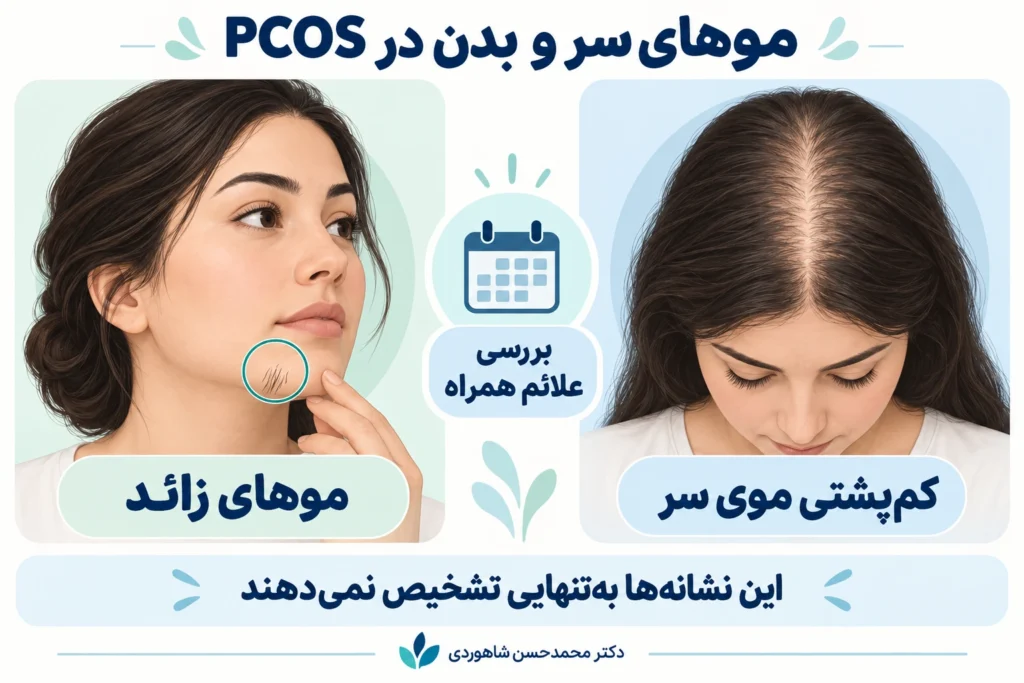
If you have PCOS and notice a wider part or more hair shedding, arrange a scalp assessment before choosing a hormone treatment or supplement. PCOS can influence hair growth, but thyroid disease, iron deficiency, recent illness and other scalp conditions can occur at the same time. The useful first question is which hair-loss pattern you have.
What PCOS-related scalp thinning can look like
Female pattern hair loss usually develops gradually, with thinning around the central part or crown. The scalp can become more visible while the front hairline is relatively preserved. A sudden shower full of shed hairs, isolated bald patches or a sore scalp deserves a broader explanation. Comparing these experiences is more useful than labelling all of them “hormonal hair loss”.
Androgens can affect scalp follicles and body hair differently. Someone may develop coarse chin hair while scalp hairs become finer. This combination can be relevant to an assessment, but it neither proves PCOS nor shows how advanced it is. Some women with pattern thinning have normal measured androgen levels.
How PCOS fits into the assessment
PCOS is assessed from the reproductive, hormonal and metabolic picture, with other explanations considered. Acne or scalp thinning alone is a weak predictor of biochemical androgen excess. Menstrual history, unwanted coarse hair, medicines and previous investigations help establish whether an endocrine assessment is appropriate.
In 2026 the syndrome was renamed polyendocrine metabolic ovarian syndrome, or PMOS. PCOS remains a familiar term in patient conversations and older records. These names refer to the same syndrome; neither means primary ovarian insufficiency or low ovarian reserve. Bring the original diagnosis and reports rather than trying to translate one label into another yourself.
Look for additional causes rather than choosing one
An illness, childbirth, rapid weight loss or another stress on the body can trigger diffuse telogen shedding after a delay. It can reveal previously subtle pattern thinning. Heavy periods, limited food intake, a thyroid disorder or inflammation may also be relevant. Finding one contributor does not make the others disappear.
Write a timeline covering the months before shedding began. Include contraception changes, pregnancy, breastfeeding, fever, surgery and new medicines. A clinician can compare that timeline with the scalp pattern. A short list of clear events is more useful than a folder of unrelated laboratory panels.
What to bring to a dermatology visit
Bring photographs showing the part and crown in similar lighting, your medicine and supplement list, previous blood results and menstrual history. Mention itching, pain, scale or eyebrow loss. The clinician may examine hair shafts and follicles with magnification and decide whether tests or a biopsy answer a specific question.
Blood tests are selected for the clinical situation; there is no universal PCOS hair-loss panel. An androgen result, ferritin value or ultrasound finding must be interpreted in context. Do not stop prescribed contraception or other medicines to obtain a “clean” result without instructions.
Separate scalp treatment from metabolic treatment
A plan can have several goals: preserving scalp hair, reducing troublesome facial hair, managing acne and supporting metabolic health. Improving one goal does not guarantee improvement in another. Metformin used for metabolic indications is not a universal hair-regrowth treatment, and supplements advertised as hormone-balancing do not replace an assessment.
Topical minoxidil may be discussed for confirmed pattern loss. Hormonal treatments or anti-androgens require individual selection, attention to pregnancy plans and appropriate follow-up. Evidence for anti-androgens specifically for PCOS-related scalp thinning is limited. A prescription should explain its purpose, expected review point and reasons to contact the prescriber.
How to choose a plan to control thinning and encourage regrowth
Start with a scalp diagnosis, then choose treatment for that diagnosis. There is no single medicine that fixes every kind of hair loss in someone with PCOS. A useful decision pathway is:
- Identify what is happening. Gradual widening of the part suggests pattern thinning; sudden shedding across the scalp may be telogen effluvium. Patches, broken hairs, redness or pain need a different assessment. The clinician combines the timeline, scalp examination and, when useful, magnification or selected tests. More than one cause can coexist. AAD explains cause-based diagnosis.
- Address an additional cause when it is found. Confirmed iron deficiency, thyroid disease or scalp inflammation needs its own plan. Correcting a contributor is different from giving everyone a supplement. Temporary shedding after an illness or another trigger may recover as that episode settles; it does not automatically require a pattern-loss prescription. BAD describes temporary shedding.
- Discuss a scalp treatment for confirmed pattern loss. Topical minoxidil is a commonly discussed option to slow loss and support some regrowth. The formulation and suitability depend on the scalp and your circumstances. Early temporary shedding can occur; persistent irritation should be reviewed. Avoid minoxidil during pregnancy, when planning pregnancy and while breastfeeding. Read AAD’s minoxidil guidance.
- Review prescription options individually. If additional treatment is appropriate, a clinician may discuss an anti-androgen such as spironolactone. The international guideline allows an anti-androgen trial with combined oral contraception for female pattern loss, while acknowledging the lack of PCOS-specific evidence. Pregnancy prevention and medication risks require a prescribing discussion; this is not an instruction to start a hormone medicine or an online DHT blocker. Metformin is selected for metabolic indications rather than as a substitute for scalp treatment. Read the international guideline.
- Make the plan assessable. Agree whether the goal is less shedding, preserving density or regrowth, and record the starting appearance. At follow-up, discuss regular use, tolerance and any change in diagnosis before switching treatments. Choosing observation or cosmetic camouflage can also be reasonable after discussing the options. PCDS explains treatment choice.
What DHT can and cannot tell you
DHT is an androgen involved in androgen-dependent follicle changes. In male pattern loss, susceptible follicles produce progressively finer hairs and have a shorter growth phase. Female pattern loss is more complex: many cases are familial or have no single identified cause, while a smaller group has androgen excess such as PCOS. The same scalp appearance therefore does not prove the same hormonal cause. PCDS describes these mechanisms.
For a PCOS endocrine assessment, the international guideline uses total and free testosterone, with other selected androgen tests when appropriate. It does not provide a blood DHT cutoff for proving that PCOS caused an individual’s thinning or for choosing a scalp treatment. Scalp thinning alone is a weak predictor of high androgens; normal results do not exclude female pattern loss. Bring menstrual changes, coarse unwanted hair and previous results to the assessment instead of selecting a DHT-blocking product from the hairline alone. See the guideline’s androgen assessment recommendations.
What you can do to reduce avoidable loss
No routine can guarantee that PCOS-associated thinning will never develop. The practical aim is to reduce additional damage and seek assessment when the pattern changes. Avoid repeatedly tight styles, harsh brushing, excessive heat and chemical damage; use gentle shampoo and conditioner. Eat enough food and protein and discuss restrictive dieting. A suspected deficiency should be assessed before adding iron or other hair supplements, because excess nutrients can also cause harm. AAD gives practical hair-care and nutrition advice.
These steps help limit breakage, traction and nutrition-related contributors; they do not replace treatment for miniaturising follicles. If pattern loss is confirmed, a suitable ongoing scalp treatment may help preserve density. Follow the agreed plan rather than repeatedly starting and stopping products, and arrange review for progressive thinning. BAD explains the aims of pattern-loss treatment.
Can it be reversed, and how long does recovery take?
The answer depends on the scalp diagnosis. Temporary telogen shedding usually settles, often over three to six months, while normal fullness takes longer. Shedding lasting more than six months is described as chronic and deserves reassessment of ongoing triggers and other causes. Female pattern loss is a long-term condition that can progress over years; there is no permanent cure. Treatment may slow progression and partly restore hair in some women, so preserving density can be a useful result even without complete regrowth. BAD: telogen recovery; BAD: pattern-loss outcomes.
If topical minoxidil is chosen, response is generally assessed after about six to twelve months of regular treatment. Its benefit usually requires continued use and is lost after stopping. This is a treatment review interval, not a fixed duration for all PCOS hair loss. Compare photographs taken under similar conditions and report worsening, side effects or new scalp symptoms sooner; do not wait for the review date when a problem develops. No treatment can promise to stop every shed hair or restore the exact previous density. AAD explains response and continued treatment.
A manageable routine and realistic follow-up
Use gentle hair care and avoid tight styles that repeatedly pull at the same area. If the scalp is irritated, ask about that before adding a new lotion. Discuss restrictive diets openly. Sustainable nutrition and activity can support overall health without a promise that weight change alone will restore density.
Hair changes take time. Agree on standard photographs and a review interval, and report side effects earlier. Judge progress against the starting pattern and your priorities rather than another person’s photographs. Worsening despite treatment should prompt a review of diagnosis, tolerance and other causes, rather than an unsupervised dose increase.
When assessment should happen sooner
Rapidly increasing coarse hair, voice deepening or abrupt severe acne needs prompt medical assessment. A painful, red or scarring scalp, sharply defined patches, loss of eyebrows or rapidly advancing thinning also deserves earlier dermatology review. These signs help set urgency; they do not identify a diagnosis from a photograph.
Pregnancy plans can change which treatments are appropriate. Discuss them before starting a medicine and tell the prescriber if pregnancy occurs. Menstrual or metabolic concerns may need gynaecology, endocrinology or primary-care input alongside the scalp assessment.
Questions patients ask
Does every woman with PCOS lose scalp hair?
No. PCOS symptoms vary, and scalp thinning needs its own examination. An ovarian diagnosis does not predict everyone’s hair outcome.
Can normal testosterone rule out pattern hair loss?
No. The hair pattern and scalp examination remain important even when hormone results fall within the laboratory range.
Will treating insulin resistance restore all my hair?
That cannot be promised. Metabolic care and scalp treatment have different aims, and additional causes of shedding may need attention.
Is PCOS hair loss the same as androgenetic alopecia?
The terms describe different things. PCOS is an endocrine and metabolic syndrome; female pattern hair loss, also called androgenetic alopecia, describes a particular scalp-thinning pattern. They can occur together, but pattern loss also occurs in women without PCOS. Having PCOS does not mean that every episode of shedding comes from that pattern. The examination still needs to distinguish gradual thinning from temporary shedding, breakage or inflammation. Read the BAD explanation of female pattern hair loss.
Does DHT explain every case of PCOS-related thinning?
No. Dihydrotestosterone, or DHT, is an androgen involved in androgen-dependent pattern loss. That mechanism is best established in male pattern loss; it should not be assumed to explain every woman’s thinning. Most female pattern loss is familial or has no single identified cause, and a smaller group has associated androgen excess, including PCOS. A normal testosterone result does not exclude female pattern loss, and thinning alone does not establish high androgens. Discuss menstrual changes, coarse facial hair and the scalp findings before choosing a “DHT blocker”. PCDS explains the distinction between male and female pattern loss.
Can hair grow back, or is PCOS hair loss permanent?
There is no single answer for everyone with PCOS. If an episode is temporary telogen shedding, it often settles as the trigger resolves, although fullness can take months to recover. Confirmed female pattern loss is a long-term condition without a permanent cure. Treatment may slow further loss and partly restore density in some women; returning every hair to its previous thickness cannot be promised. Both processes can coexist. Ask which diagnosis is being treated and whether the goal is less shedding, preserved density or regrowth. The BAD telogen-effluvium guide explains temporary shedding.
How long should I wait to judge improvement?
The interval depends on the diagnosis and treatment, rather than the PCOS label alone. Temporary telogen shedding often lasts around three to six months, with recovery of volume taking longer. If topical minoxidil is selected for confirmed pattern loss, its benefit is usually judged over about six to twelve months, not after a few days. Continued treatment is generally needed to maintain its benefit. These are general expectations, not a deadline or a promise for your scalp. Contact the clinician earlier for adverse effects or worsening loss. Minoxidil should be avoided during pregnancy, when planning pregnancy and while breastfeeding. AAD describes minoxidil follow-up and pregnancy precautions.
Arrange a skin and hair assessment with Dr Shahverdi
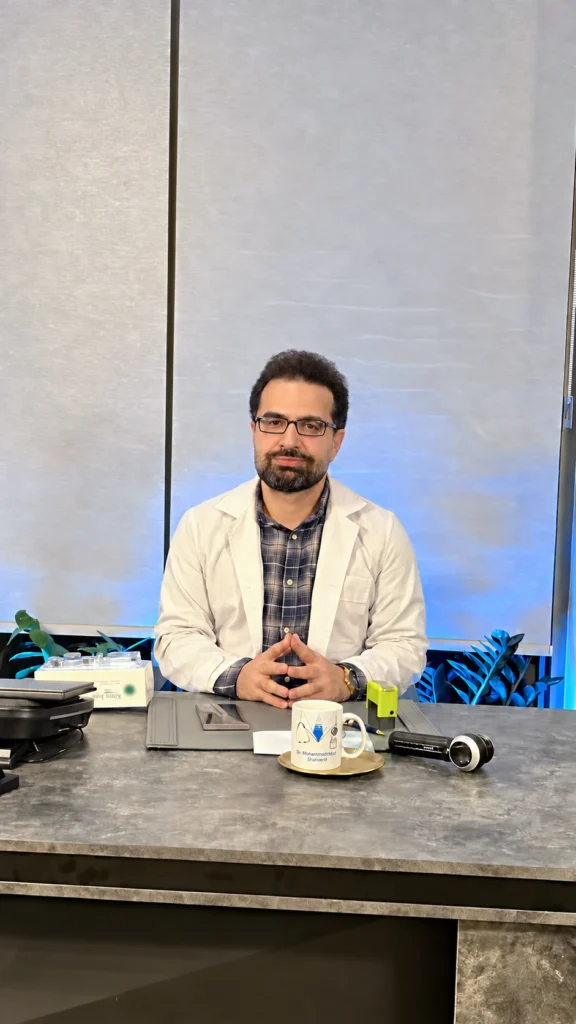
Bring the symptom timeline, medicines and previous reports to discuss the examination and next step. Dr Mohammad Hassan Shahverdi’s dermatology clinic is in Niavaran, Tehran. Contact the clinic for appointment arrangements and language requirements.