Hormone tests for acne, facial hair and hair loss in women: when they are useful
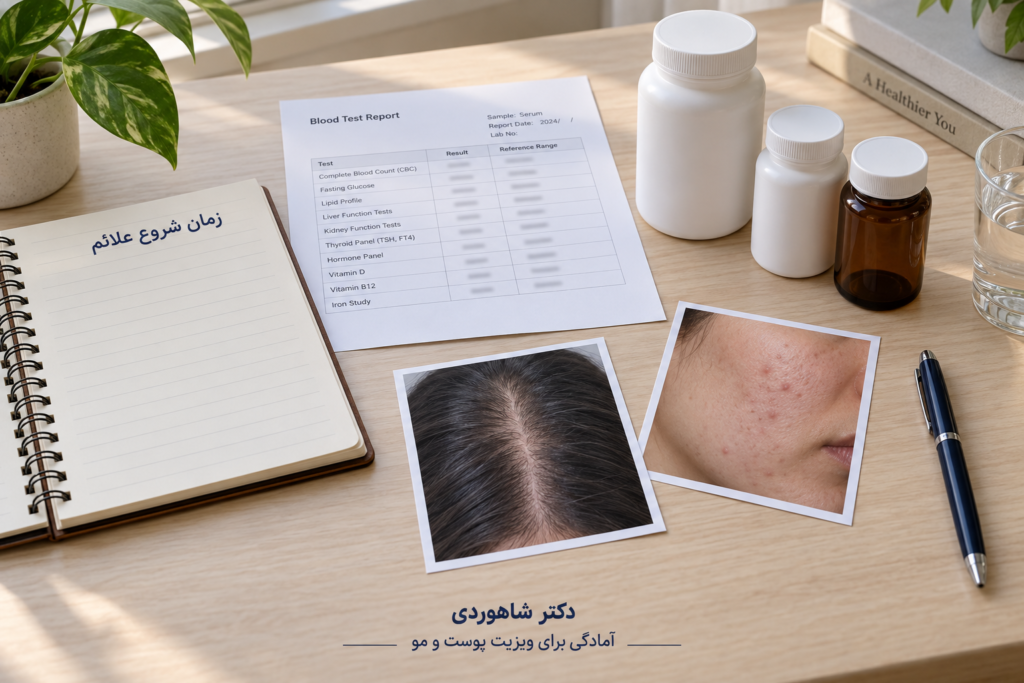
There is no single hormone panel that explains every case of acne, facial hair or scalp thinning. Testing is useful when it answers a question raised by the history and examination. Bring existing results and a symptom timeline; do not order a large panel or stop prescribed medicines before the reason for testing is clear.
Start with the pattern, not the laboratory menu
What happened, when did it begin, and how quickly is it changing? Persistent acne, a widening part, diffuse shedding and newly coarse chin hair are distinct observations. The menstrual history, medications, pregnancy possibility and accompanying symptoms help decide whether hormone assessment is relevant.
A scalp and skin examination can reveal clues that a blood panel cannot. Normal hormone values do not rule out every dermatological problem, and an abnormal value does not automatically explain the symptom. The clinician should be able to state the question a test is intended to answer.
When acne raises a hormone question
Adult acne may be influenced by hormones, but jawline location or a menstrual flare alone does not establish PCOS/PMOS. Irregular cycles, coarse hair growth or other findings can make androgen evaluation more relevant. Products, friction, medication effects and acne-like conditions also need consideration.
Tell the clinician about acne severity, scarring, previous treatment and the effect on daily life. Acne without hirsutism is a relatively weak predictor of biochemical androgen excess in the international guideline. Skin treatment and assessment of a possible endocrine cause are complementary decisions.
When coarse hair growth is different from fine facial fuzz
Hirsutism concerns coarse terminal hair in an androgen-sensitive pattern. A few unwanted hairs or normal facial fuzz do not automatically justify the same work-up as progressive hirsutism with menstrual disturbance. Mention removal methods and how frequently they are needed, since the visible pattern can be partly hidden.
Guideline-based assessment considers the extent, severity and progression of the findings. Selected androgen measurements or other tests may be appropriate. Rapid progression or virilisation changes urgency and may require a broader specialist evaluation rather than a routine hair-removal consultation.
A hair-loss assessment is more than hormones
Female pattern thinning, telogen shedding, alopecia areata and scarring disorders have different clinical patterns. Blood androgen results may be normal in female pattern hair loss. The examination, family history, recent illness, childbirth, weight changes, hair practices and medication timeline remain important.
Iron or thyroid assessment may be considered where relevant. It is not necessary to test every vitamin and hormone automatically. A painful or inflamed scalp, a scarred area, eyebrow loss or rapidly progressing recession needs dermatological assessment before relying on a general blood panel.
Testosterone, free androgen assessment and DHEAS
These tests answer different questions about androgen activity or its possible source. Results depend on the assay, reference range and clinical context. The choice of total testosterone, free androgen assessment or an adrenal-related marker belongs to the evaluation prompted by the symptoms.
A value just outside a range is not a standalone diagnosis. Conversely, significant symptoms may need assessment despite a previous result within range. Bring the actual laboratory report instead of a handwritten number. Do not compare results from different laboratories without checking units and methods.
Why prolactin, thyroid tests and 17-hydroxyprogesterone may be selected
These tests are used for particular differential diagnoses when the history or examination supports them. Menstrual disturbance, relevant family history or additional symptoms can change the question being investigated. They are not interchangeable with a general test for “hormone balance.”
Your clinician should explain why a test is included and what would follow from an abnormal result. If no change in management would follow, ask what useful information it provides. A targeted plan reduces the confusion caused by incidental findings in an indiscriminate panel.
Timing and medicines can affect interpretation
The appropriate time of day, menstrual-cycle context or fasting requirements depend on the actual test. Ask the ordering clinician or laboratory what applies to your prescription. If cycles are absent or irregular, tell them rather than guessing a cycle day.
Hormonal contraception and some other treatments can affect hormone assessment. Supplements, including biotin, may interfere with some laboratory assays. Provide the full list and follow specific professional instructions; do not discontinue prescribed treatment or contraception simply because an internet page suggests a washout period.
Glucose tests and insulin tests are different
Fasting glucose, HbA1c and an oral glucose tolerance test examine glycaemic health in different ways. The clinician selects them for a particular context, including risk assessment in PCOS/PMOS where appropriate. A glucose tolerance test is not a direct measurement of insulin resistance.
Routine clinical insulin assays have limits and are not universally recommended for everyday PCOS care. HOMA-IR is a calculation whose interpretation depends on context; a single online cutoff cannot replace assessment. The absence of a visible metabolic skin sign does not prove that glucose assessment is unnecessary.
AMH, ultrasound and ovarian tests have limited roles
An AMH result should not be used by itself to diagnose PCOS, POI or the cause of hair loss. Ultrasound also answers specific reproductive questions rather than identifying every hormonal skin complaint. Interpretation may differ with age, symptoms, treatments and the clinical purpose.
The current PCOS guideline provides an adult diagnostic framework and different cautions for adolescents. Ovarian reserve, ovarian insufficiency and PCOS are separate concepts. If a report has been explained only as “weak ovaries,” ask for the precise diagnosis and what the result changes in your care.
Reading results without creating a diagnosis from one number
Keep the report date, units, laboratory reference interval and medicines taken at the time. At the visit, ask whether the result fits the symptoms, whether it should be repeated, and whether another explanation remains possible. Avoid assigning every complaint to the first highlighted value.
Reference intervals and decision thresholds do not all mean the same thing. A clinician may interpret a result differently in a particular clinical context. Repeating a test is useful only when there is a clear reason and an appropriate plan, rather than an attempt to chase a preferred number.
When further specialist assessment is appropriate
Marked menstrual changes, suspected POI, substantial androgen findings or metabolic concerns may require coordination with gynaecology, endocrinology or primary care. Fertility, IVF and personalized pregnancy management are separate specialist questions. A dermatology appointment can still help establish and manage the actual skin or hair condition.
Seek prompt review for rapidly developing coarse hair with voice change or other virilisation, severe progressive symptoms or potentially scarring scalp disease. If you feel acutely unwell, seek urgent medical care instead of waiting for a routine testing appointment.
A test result should lead to a clear plan
Testing is not a treatment. Ask what diagnosis is being considered, whether direct skin or hair therapy is needed, and how benefit and adverse effects will be assessed. Pregnancy possibility, breastfeeding, other illnesses and concurrent medicines can materially change treatment choices.
Anti-androgens, hormonal contraception, isotretinoin, metformin and hair-loss treatments require different safety discussions. No search phrase, reference range or online forum can determine a personal dose or a start-and-stop plan. Bring questions about supplements and existing prescriptions so that the entire regimen can be reviewed.
A short preparation list makes the visit more useful
Bring a timeline of periods and symptoms, prior test reports, medicines and supplements, photographs taken under comparable conditions, and the treatments already tried. Include what helped, what irritated the skin and why a treatment was stopped. Mention pregnancy plans early.
Write down the two or three outcomes you most want from the appointment. For example: understanding the type of hair loss, reducing painful acne, or deciding whether hormonal referral is necessary. This helps the consultation end with practical steps instead of a collection of unexplained test names.
Agree on the next review before leaving
Ask which changes to track and when to review the results or treatment. The useful outcome may be symptom control, a clarified diagnosis or a decision about referral. Photographs, discomfort and flare frequency can be more informative than repeated unscheduled panels.
Contact the clinician if symptoms accelerate, adverse effects develop or pregnancy plans change. Do not repeat large panels or escalate treatment yourself in response to an isolated number. Follow-up should revisit the whole clinical picture.
Questions patients ask
Do all women with acne need hormone tests?
No. The history and examination determine whether tests can answer a useful clinical question.
Which cycle day should I choose?
The instructions depend on the particular test and your cycle pattern. Follow the ordering clinician’s or laboratory’s advice.
Should I stop my contraceptive pill before testing?
Do not stop prescribed treatment yourself. The clinician decides whether an altered testing plan is needed and addresses contraceptive safety.
Can a normal blood panel exclude a scalp disorder?
No. Several forms of hair loss are identified primarily through history and scalp examination.
Does high insulin or low AMH explain every skin symptom?
No. Each result has a specific interpretation and cannot replace a dermatological or reproductive assessment.
Can I bring reports ordered elsewhere?
Yes. Bring the original report, date, units and the medication context so that the clinician can assess its relevance.
Arrange a skin and hair assessment with Dr Shahverdi
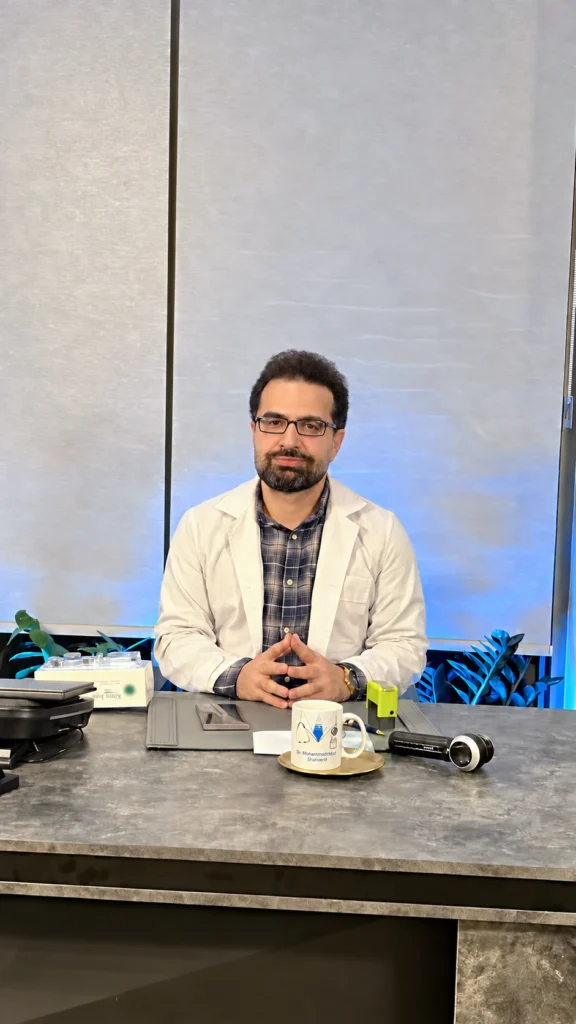
Bring the symptom timeline, medicines and prior reports so that the skin or scalp findings can be examined and the next step discussed. Dr Mohammad Hassan Shahverdi’s dermatology clinic is in Niavaran, Tehran. For appointment arrangements and language requirements, contact the clinic.